

Three ways to connect
MCP server
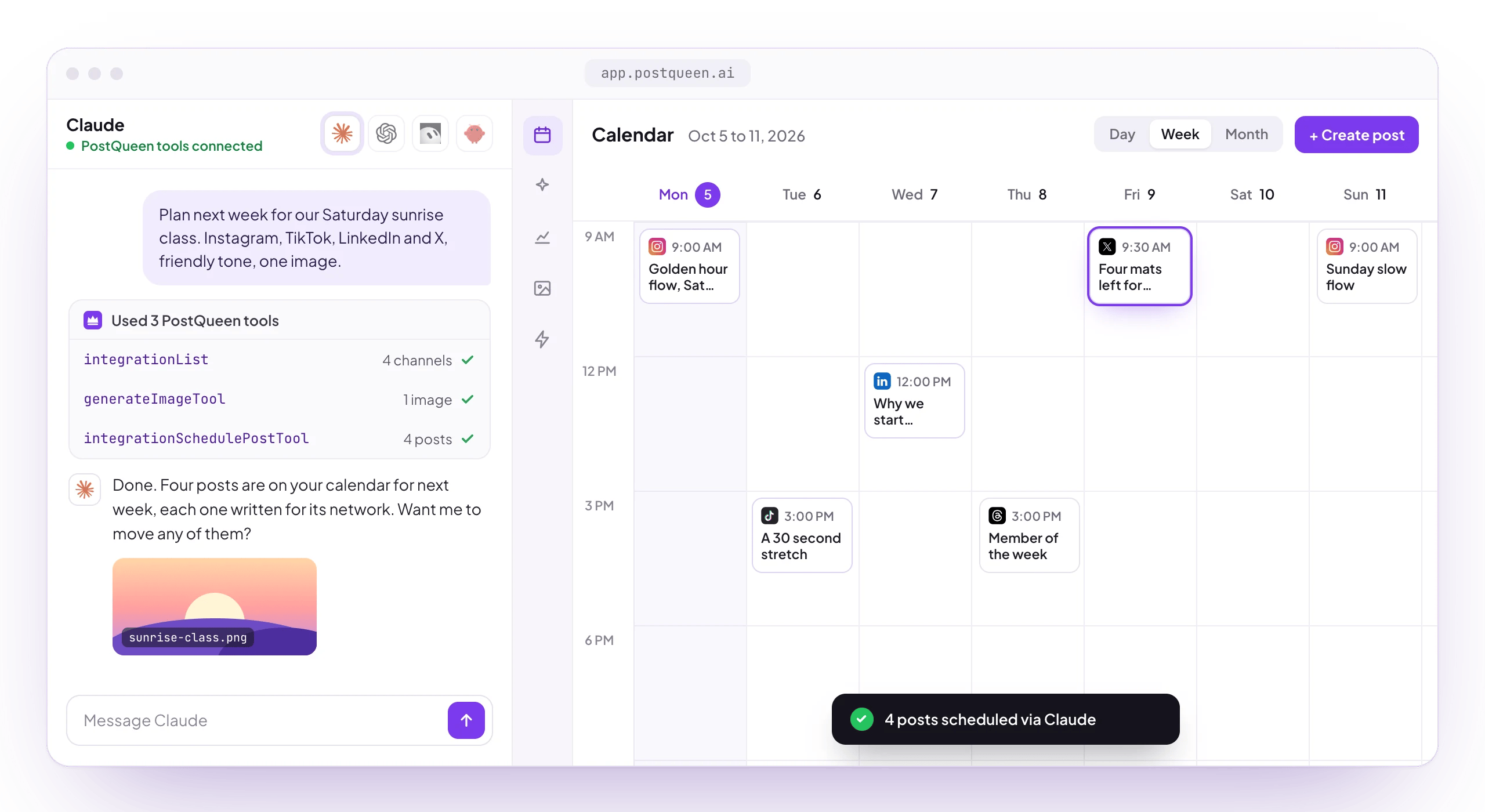
For chat assistants and most coding agents. Paste one address and the agent gets 22 tools. Nothing to install.
CLI and skill
For agents that run shell commands, and for your own scripts. The
postqueen command, plus a skill that teaches it to the agent.Public API
For your own apps and automations. REST calls with your API key.
Connect channels and edit a post’s text or time in the app.
Before you start
- A PostQueen workspace on a trial or a paid plan. Agents post through your workspace, so its plan limits apply to them too.
- A workspace admin. Only an Admin or Super Admin can reveal the API key or approve a sign-in.
- At least one connected channel. An agent posts only to channels you connected in the app. See connect a channel.
Where the API key is: in the app, open Connections > API Keys. Only a workspace Admin or Super Admin can reveal or rotate it; other members see it masked. A workspace has one key, and each agent card on Connections shows your MCP address with the key already filled in.
Every agent
How it connects is what you set up in the agent. Sign-in or key says whether the agent can sign in to PostQueen or takes your API key.Assistants and bots
Coding agents
Editors and more
Muse and Muse Code are two different Meta products. Muse Code, the coding agent, connects with the key address. Muse, the personal agent, connects through a custom connector it builds with you in chat.
You stay in charge
Drafts wait for you
Ask for drafts and they stay on your calendar until you schedule them.
Every post on your calendar
You see each post before it goes out, and you can edit or delete it until its time.
Access you can take back
An admin rotates the API key under Connections > API Keys, which stops every agent that used it, or revokes one sign-in under Connections > Approved Apps.
No social passwords
The agent never sees the passwords of your social accounts. It works through PostQueen, which posts with each network’s own API.
Next steps
The MCP server
The three addresses, what each one gives an agent, and how to check it works.
The MCP tools
What each of the 22 tools does, and what an agent cannot do.
The CLI
Install
postqueen, set the key and schedule a first post from a terminal.Troubleshooting agents
What to do when a connection or a command fails.