

Before you start
- Plans: Plus, Pro, Business, Enterprise and Education, on the web. Not Free. OpenAI’s pages disagree on which plans can make changes such as scheduling a post, so check yours on OpenAI’s developer mode help page.
- Platforms: ChatGPT on the web only.
- A PostQueen API key. A workspace admin copies it, or the ready-made address, from Connections.
Where the API key is: in the app, open Connections > API Keys. Only a workspace Admin or Super Admin can reveal or rotate it; other members see it masked. A workspace has one key, and each agent card on Connections shows your MCP address with the key already filled in.
Connect ChatGPT
These steps use the key address with No Authentication. To sign in instead of using a key, see Other ways to connect.1
Turn on developer mode
In ChatGPT on the web, open Settings > Security and login and turn on Developer mode. On Business, Enterprise and Education, an admin first allows it under Workspace settings > Permissions & roles.
2
Create the app
Go to chatgpt.com/plugins and press +. Enter the name
PostQueen and a short description, and under Connection enter your key address:3
Choose No Authentication
Set Authentication to No Authentication, since the key is part of the address, and create the app. It appears under Drafts.
4
Select it in a chat
In a chat, open the + menu, choose Developer mode and select PostQueen.
Check that it works
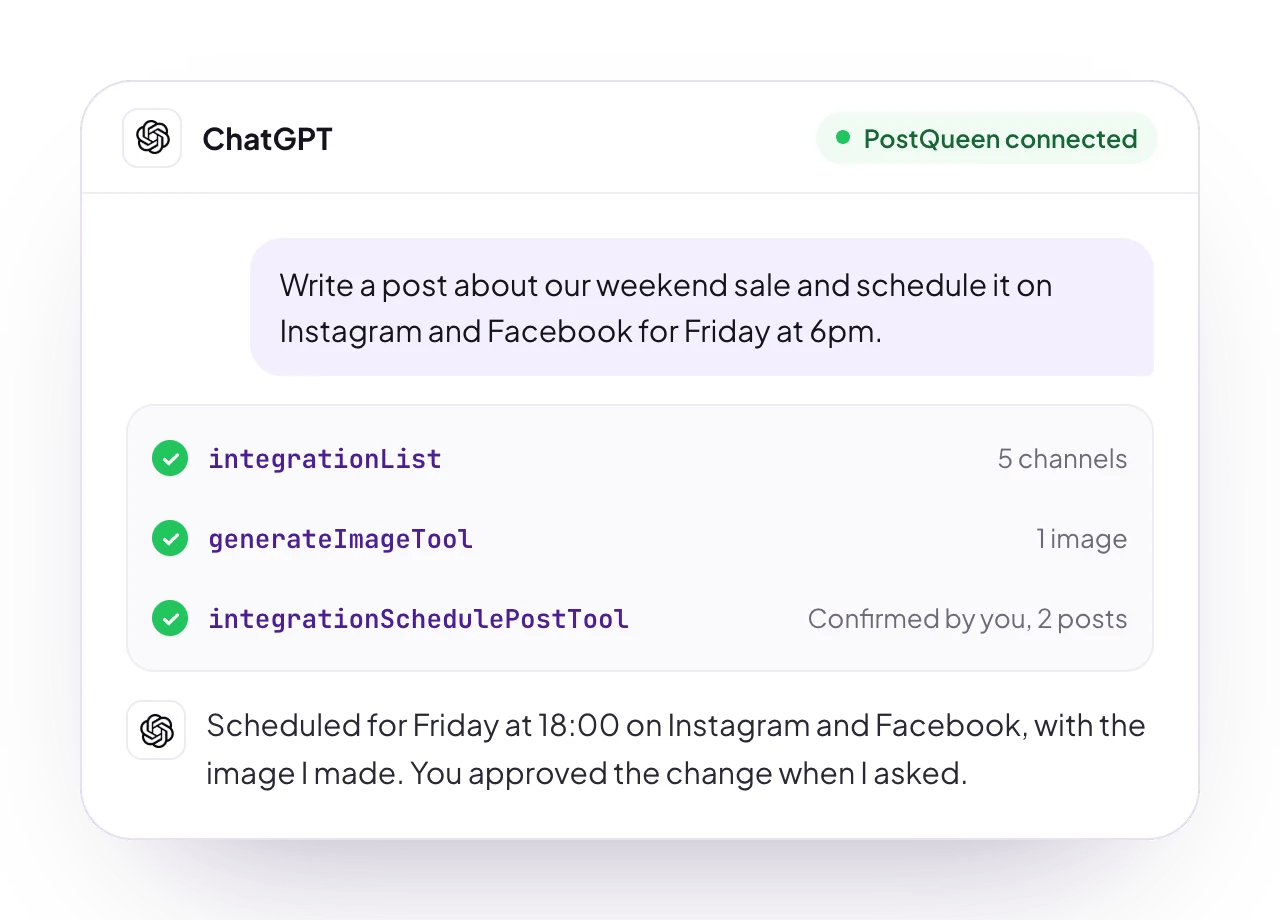
Ask ChatGPT: “List my PostQueen channels.” It answers with the channels you connected in PostQueen. ChatGPT asks you to confirm each action that changes something, such as scheduling a post; review what it will send, then confirm.Good to know
- The Plugins page is the current path. Guides that say Settings > Apps > Advanced settings describe the older menus.
- ChatGPT cannot add PostQueen for you. It works with the tools once you add the app yourself.
- The address carries your API key. Keep it private. If it leaks, a workspace admin rotates the key under Connections > API Keys, and you update the app.
- Upload from your device. PostQueen’s upload widget opens an Upload Media panel in ChatGPT, where you add a photo or video from your device.
- The ChatGPT desktop app’s MCP servers setting belongs to Codex, not to the web chat. Add PostQueen on the web.
- ChatGPT cannot run the PostQueen CLI. Use the MCP address.
- Ask for drafts when you want to check first. A draft waits on your PostQueen calendar, and nothing publishes until you schedule it.
- What it cannot do over MCP: delete a post, or change a post’s text or time. Do that on the calendar in the app. The MCP tools lists what it can do.
Other ways to connect
The key address has 22 tools. The sign-in address has 21, all but
ask_postqueen.
Sign in with PostQueen instead
Sign in with PostQueen instead
With the sign-in, no key is copied or stored in ChatGPT. Only a workspace admin can approve it.The access does not expire on its own. Revoke it in PostQueen under Connections > Approved Apps.
1
Create the app with the sign-in address
At chatgpt.com/plugins, press +, enter the name
PostQueen and a description, and under Connection enter https://api.postqueen.ai/mcp-oauth-dynamic.2
Choose OAuth
Set Authentication to OAuth and create the app. Sign in to PostQueen and approve.
3
Select it in a chat
Open the + menu, choose Developer mode and select PostQueen.
Try this first
Troubleshooting
More fixes are on Troubleshooting agents.
Is it the same as Codex?
No. OpenAI’s coding agent, Codex, has its own setup:
ChatGPT on the web does not read Codex’s config, so a server you add to Codex does not reach the web chat.
Next steps
Every agent
Which agents can post to PostQueen, and how each one connects.
The MCP tools
What each of the 22 tools does, and what an agent cannot do.
Prompts and tool calls
The order an agent calls the tools in, with prompts that work.
Troubleshooting agents
What to do when a connection or a command fails.