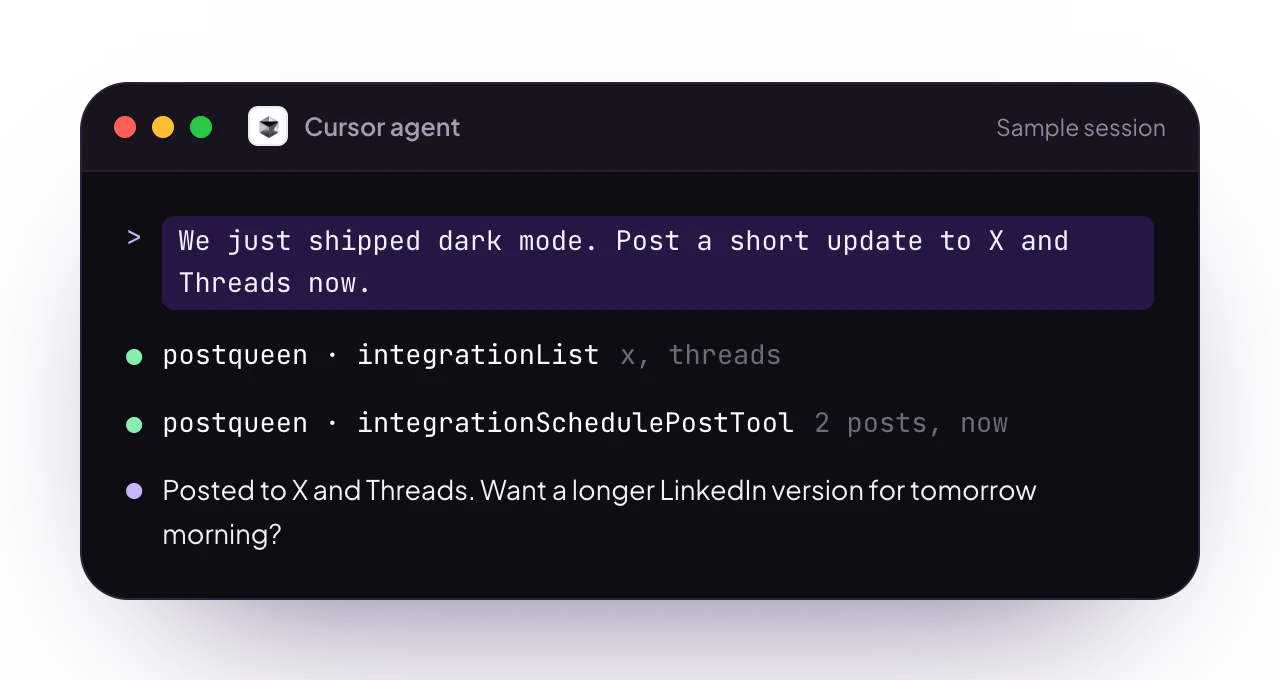
Working with her inside the editor

Cursor is the AI code editor with an agent mode and MCP support, which means she can sit right beside the diff you just merged. The changelog entry and the launch post are usually the same idea written twice, and the agent already has the first one open. Ask for the second and it lands on your calendar without a context switch.

Set up

Two routes, and you can take either. MCP is the native one here: Cursor’s agent gets her 11 hosted tools and asks for your approval before it calls them. Her skill plus the postqueen CLI is the other, and it suits the agent terminal when you would rather see the exact command that ran.
1

Grab your API key

Your key lives in the app at app.postqueen.ai: open Settings > Developers > Public API and click Reveal. Both routes below use this one key. Treat it like a password, since it grants full access to your account.
2

Route A: connect over MCP

One entry in ~/.cursor/mcp.json and her tools appear in every project. The file, the Settings UI route, the header variant and self-hosted URLs are all on Cursor over MCP.
Put it in ~/.cursor/mcp.json rather than the project’s own .cursor/mcp.json, or your API key travels into the repository with it.
3

Route B: install the CLI and her skill

The skill is her SKILL.md, and it teaches the agent her command set before it runs anything. Then export the key in the shell Cursor’s terminal inherits:
Self-hosting PostQueen? Point the CLI at your backend URL, the same value as NEXT_PUBLIC_BACKEND_URL. Most single-domain setups serve the backend under /api:
4

Verify the connection

In agent mode, ask: “List my connected social media accounts.” Over MCP the agent calls integrationList; over the CLI it runs:
A JSON list of your channels with their integration IDs means she is ready.

👑 Posts about the feature you just shipped

The saved-views branch is merged and the changelog is written. Ask in the same window:
“We just shipped saved views. Read the changelog entry, draft three posts about it for X, LinkedIn and Bluesky, and hold them as drafts.”
It reads the repo for the source material, then discovers where the posts can go:
Before writing a word, it asks each channel what it accepts. The response carries character limits and required settings, so a LinkedIn draft does not arrive shaped like a tweet:
Then it creates each post with -t draft, which saves it to the calendar rather than queueing it for publishing. The settings schema is validated even for a draft, so X still needs its who_can_reply_post value:
For a whole set at once, the agent can write a campaign file and pass it with --json, which is the cleaner path when the copy differs per channel. The file is the request body her API receives, so it carries the top-level type, date, shortLink and tags alongside one entry per channel:
launch-week.json
image is required on every entry, so pass [] when a post has no media. Any value inside it has to be a URL returned by postqueen upload, the same rule that applies to -m. The rules in full: Media upload.
The three drafts are now on your calendar at app.postqueen.ai. Edit the copy there and publish when you are happy, or promote one from the terminal:
She runs on your terms. A post you schedule goes out at its time without another word from you, everything is visible on the calendar before it publishes, and a draft stays unscheduled until you publish it.

FAQ

No. She works on her own through the dashboard, the CLI and the public API. Cursor is one of several ways to automate her, and the one to pick when the announcement should be written where the code is.
MCP is the smoother fit for agent mode: 11 tools, no local install, and an approval prompt before each call. The CLI is better when you want the exact command visible in the terminal, or when you plan to reuse the same script in CI later. Configuring both is fine.
Yes, and that is the point of running her here. Cursor’s agent can read your changelog, your release notes or the diff itself, then turn them into posts shaped for each channel. You still see every draft on the calendar before anything reaches an audience.
Only if you set it up that way. Cursor asks for approval before running MCP tools by default, so keep that on for integrationSchedulePostTool. On the CLI side, -t draft saves each post to the calendar without scheduling it.
Yes. PostQueen connects 30+ networks, so the same brief can become posts for every channel you have connected, each one adapted to what that channel accepts.

Learn more

Cursor over MCP

The full .cursor/mcp.json reference, the Settings UI flow and self-hosted URLs.

CLI introduction

The postqueen CLI behind Route B, with installation and the full command set.

Why agents love her

Why an agent can drive her without guesswork, and the two rules that matter most.

Agents overview

Every way to put an agent in front of PostQueen, from coding assistants to chat apps.