> ## Documentation Index
> Fetch the complete documentation index at: https://docs.postqueen.ai/llms.txt
> Use this file to discover all available pages before exploring further.
> ## Agent Instructions
> PostQueen's hosted API is https://api.postqueen.ai. The public API base is https://api.postqueen.ai/public/v1 and takes the raw API key in the Authorization header, with no Bearer prefix.
> The MCP server for posting is https://api.postqueen.ai/mcp/YOUR_API_KEY (or /mcp with Authorization: Bearer YOUR_API_KEY). docs.postqueen.ai/mcp only searches these docs and cannot post.
> The API key is under Connections > API Keys in the app, and only workspace admins can see it.
# Listmonk
> Connect your Listmonk server to PostQueen with an API user, what a scheduled campaign contains, and the limits PostQueen checks before it is scheduled.
export const ChannelStatus = ({status, children}) => {
const look = ({
available: {
color: 'green',
label: 'Available'
},
'in-review': {
color: 'yellow',
label: 'In review'
},
soon: {
color: 'gray',
label: 'Soon'
}
})[status] || ({
color: 'gray',
label: status
});
return
{look.label}
{children ? {children} : null}
;
};
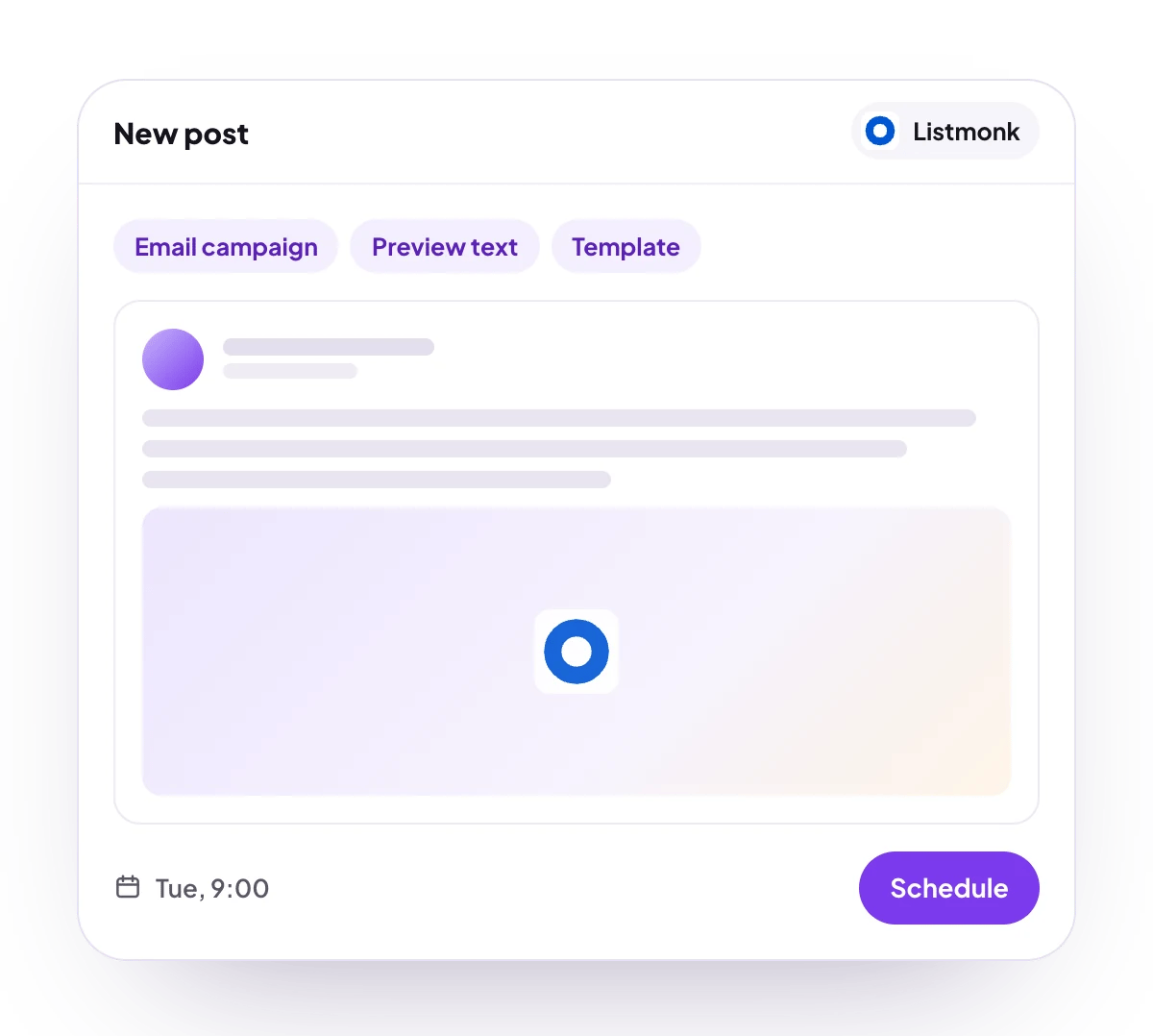
Send email campaigns from your own Listmonk server on schedule, with a subject, preview text, one list and an optional template. At the scheduled time PostQueen creates the campaign on your server and starts sending it.
## What you can post
Up to 300,000 characters in the editor, sent as an HTML email with basic formatting.
None. Images you attach in the editor are not sent.
An email campaign to one list, with a subject, preview text and your default or chosen template.
No analytics for Listmonk.
**Not supported:** several lists in one campaign, Markdown or plain-text campaigns, images from the editor, Listmonk's own send date, and follow-ups.
## Checked before scheduling
PostQueen refuses a post that breaks these rules and shows the message in the composer:
| Rule | Message |
| ------------------------------ | ------------------------------------------------------ |
| A subject | “subject must be longer than or equal to 1 characters” |
| A list is picked | “list must be a string” |
| Text within 300,000 characters | “post is too long, please fix it” |
A list your server no longer has is not checked first: Listmonk refuses the campaign when it is created.
## Connect Listmonk
Your Listmonk server has to be reachable from the internet. PostQueen talks to its API with an API user, not with your admin login.
In your Listmonk admin, open **Admin**, then **Users**, and create a user of the API type. Give it a role that can read settings, lists and templates, and create and send campaigns. Copy the token Listmonk generates for it.
In PostQueen, open **Channels** and choose **Add Channel**, then **ListMonk** and **Enter details**.
Type your Listmonk root address in **URL**, for example `https://mail.example.com`, the API user's name in **Username** and its token in **Password**. Choose **Connect**.
The channel appears in the **Channels** list with your Listmonk site name and logo.
**Never share your API keys, passwords or access tokens with anyone, including PostQueen staff.**
A key, app password or private key a channel asks for goes into its connect form in PostQueen and nowhere else. Nobody from PostQueen will ask you to send one by email or chat, and you can disconnect the channel at any time.
## Post settings
Each Listmonk post in the composer has these settings:
* **Subject**: the email subject. Required.
* **Preview**: the preview text inboxes show next to the subject. It is added to the email as hidden text and can be left empty.
* **Select List**: who receives the campaign. Required, and one list per campaign.
* **Select Template**: **Default**, or one of the templates on your server.
The body of the post becomes the body of the email. The field names and values for the API are on [Listmonk posting settings](/public-api/providers/listmonk).
## Comments and threads
Listmonk takes no follow-up comments, so the composer shows no **Add comment** button for a Listmonk post.
## Good to know
* At the scheduled time PostQueen creates a regular campaign and sets it running, so it starts sending straight away. It is not left as a draft for you to send.
* The campaign is named after its subject.
* The link on a sent campaign opens its preview on your Listmonk server.
* Only servers reachable on the public internet can be connected. An address on a private or local network is refused.
* If you change or delete the API user's token, publishing stops. Enter the new one with **Update Credentials** under **Access** on the channel's page.
* **Invite by link** does not offer Listmonk, because the token is typed into PostQueen. Connect it with **Connect myself**.
* During the free trial, a Listmonk server that another PostQueen workspace already connected is refused until you end the trial.
## Troubleshooting
Listmonk refused the API user or the token, or PostQueen could not reach the server. Check **URL**, the user's name and the token, and that the API user's role can read settings.
**Select List** and **Select Template** show what the API user may read. Give its role access to that list or to templates in Listmonk, then open the post again.
## Next steps
Write once for several channels, then schedule it, save a draft or post now.
Which networks you can connect today, what each one posts, and its text limit.
Ask Claude, ChatGPT, Grok Bot or another agent to schedule the post for you.
Why a post fails and what to do about it.